Introduction
Drone technology has transformed the surveying industry by making data collection faster, safer, and more accurate. From construction sites and mining projects to agriculture and infrastructure development, drones are now widely used for mapping and measurement tasks. As a result, the demand for skilled professionals in this field continues to grow.
If you are interested in technology, mapping, and land measurement, becoming a Drone Surveyor can be an exciting and rewarding career choice. This profession combines traditional surveying knowledge with modern aerial data collection techniques, creating opportunities across multiple industries.
What Does a Drone Surveyor Do?
A Drone Surveyor uses unmanned aerial vehicles (UAVs) to capture images and collect geospatial data. This information is then processed into maps, 3D models, contour plans, and digital terrain models that support engineering, construction, and land development projects.
Unlike conventional surveying methods, drone-based surveys can cover large areas in a shorter time while maintaining high accuracy. The collected data helps project managers, engineers, and landowners make informed decisions.
Why Is Drone Surveyor Becoming Popular?
The popularity of drone surveyor has increased because it offers several advantages over traditional methods. Drones can access difficult terrain, reduce fieldwork time, improve safety, and provide highly detailed aerial imagery.
Businesses and government agencies are adopting drone technology to improve efficiency and reduce project costs. As more organizations embrace aerial surveying, career opportunities in this field continue to expand.
Educational Background Required
To become a Drone Surveyor, having a background in surveying, civil engineering, geomatics, geography, or geospatial science can be beneficial. However, individuals from various educational backgrounds can enter the field by acquiring the necessary technical skills and certifications.
Basic knowledge of land surveying principles, mapping techniques, coordinate systems, and GIS software helps aspiring professionals understand the fundamentals of drone-based surveying. A strong understanding of mathematics and data analysis can also support career growth as a Drone Surveyor.
Learn Drone Operations
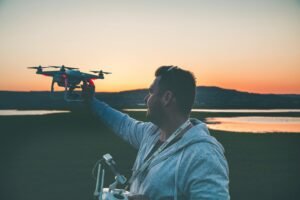
Operating a drone professionally requires more than simply flying it. Aspiring professionals must learn flight planning, equipment maintenance, safety procedures, and data collection techniques.
Training programs teach students how to conduct aerial missions efficiently while following aviation regulations. Practical flight experience is essential because survey accuracy often depends on proper mission planning and execution.
A future Drone Surveyor should spend time mastering both manual and automated flight operations
Obtain Professional Certification
Certification is an important step for anyone planning to work in commercial drone operations. Certified professionals demonstrate their understanding of aviation safety, regulations, and operational procedures.
Many employers prefer candidates who have completed recognized drone training programs. Certification can also improve credibility when working with clients or applying for specialized surveying projects.
As regulations evolve, keeping certifications updated is important for long-term career growth.
Develop Data Processing Skills
Collecting aerial data is only one part of the job. After a flight mission, the information must be processed into useful outputs such as maps and models.
Professionals in this field commonly use photogrammetry software, GIS platforms, and CAD applications. Learning how to analyze and interpret geospatial data can significantly increase employability.
Strong software skills often distinguish an experienced professional from an entry-level operator.
Gain Practical Experience
Hands-on experience is one of the most valuable aspects of career development. Working on real projects helps individuals understand field conditions, client requirements, and data quality standards.
Many beginners start by assisting survey firms, engineering consultants, or drone service providers. These opportunities provide exposure to different project types and help build technical confidence.
Over time, practical experience allows professionals to handle increasingly complex assignments.
Industries That Hire Drone Survey Professionals
Career opportunities exist in a wide range of industries. Construction companies use drones for site monitoring and progress tracking. Mining organizations rely on aerial surveys for stockpile calculations and terrain analysis.
Agriculture businesses use drone technology to monitor crop health and improve productivity. Government departments apply aerial mapping for land management, infrastructure planning, and urban development projects.
Environmental agencies also use drones for conservation efforts, disaster assessment, and resource monitoring.
Essential Skills for Success
Success in this profession requires a combination of technical and analytical skills. Knowledge of surveying principles, aerial mapping, GPS technology, and geospatial software is highly valuable.
Attention to detail is equally important because small errors in data collection can affect project outcomes. Communication skills help professionals work effectively with engineers, architects, contractors, and clients.
Continuous learning is essential because drone technology evolves rapidly and introduces new capabilities each year.
Career Growth Opportunities
The future of aerial surveying looks promising. Advances in technologies such as LiDAR, artificial intelligence, and automated flight systems are creating new possibilities for data collection and analysis.
An experienced Drone Surveyor may advance into project management, geospatial analysis, consulting, or training roles. Some professionals establish their own surveying businesses and provide specialized mapping services to clients across different industries.
As demand continues to increase, skilled individuals can expect strong career prospects and competitive earning potential.
Conclusion
Becoming a Drone Surveyor offers an excellent opportunity to work at the intersection of technology and surveying. The profession provides diverse career options, exposure to innovative tools, and opportunities to contribute to major development projects.
By learning drone operations, obtaining certification, mastering mapping software, and gaining practical experience, aspiring professionals can build a successful and rewarding career. With industries increasingly relying on aerial data, the demand for qualified experts is expected to remain strong for years to come.