
RTK surveys have emerged as one of the most reliable survey strategies for initiatives that require tremendously accurate positioning and mapping data. Whether in land reclamation, production, infrastructure planning, farming, mining, or drone mapping, RTK technology enables surveyors to achieve centimeter-degree accuracy in real-time Compared to standard GPS-based positioning, RTK surveys instantly provide particular coordinates to significantly reduce errors and improve field productivity
What Is RTK Survey?
RTK survey is a survey method that uses real-time dynamics (RTK) positioning to improve the accuracy of global navigation satellite system (GNSS) measurements RTK is a differential positioning technique based on correction information from a reference station to decorate the location calculated through a cell receiver.
Definition
RTK surveys are high-accuracy GNSS surveys that use real-time corrections from a base station or correction grid to decide exact locations within the field According to the European Space Agency (ESA), RTK installations use provider block measurements to achieve centimeter-degree accuracy.
What Does RTK Stand For?
RTK stands for Real-Time Kinematic. The term “real-time” refers to the immediate application of correction data, while “kinematic” refers to determining positions while the survey equipment is moving.
RTK Survey vs Traditional Surveying
Traditional surveying often relies on total stations, levels, and manual calculations. While these methods remain effective, they can require more time and manpower. RTK Survey provides accurate coordinates directly in the field, reducing the need for extensive post-processing and manual calculations.
How RTK Survey Works
RTK Survey works by combining GNSS satellite signals with real-time correction data. The system uses a reference station with known coordinates and a rover receiver operating in the field.
GNSS Satellites and Positioning
GNSS includes several satellite constellations such as GPS, GLONASS, Galileo, and BeiDou. These satellites continuously transmit signals that are received by both the base station and rover receiver.
The rover calculates its position using satellite signals, while the base station determines the errors affecting those signals and generates correction information.
RTK Base Station
The RTK base station is installed at a known location. Since its exact coordinates are already established, it can compare its calculated position with its true position and determine measurement errors.
These errors may result from atmospheric delays, satellite orbit inaccuracies, satellite clock errors, and other factors affecting GNSS positioning.
RTK Rover
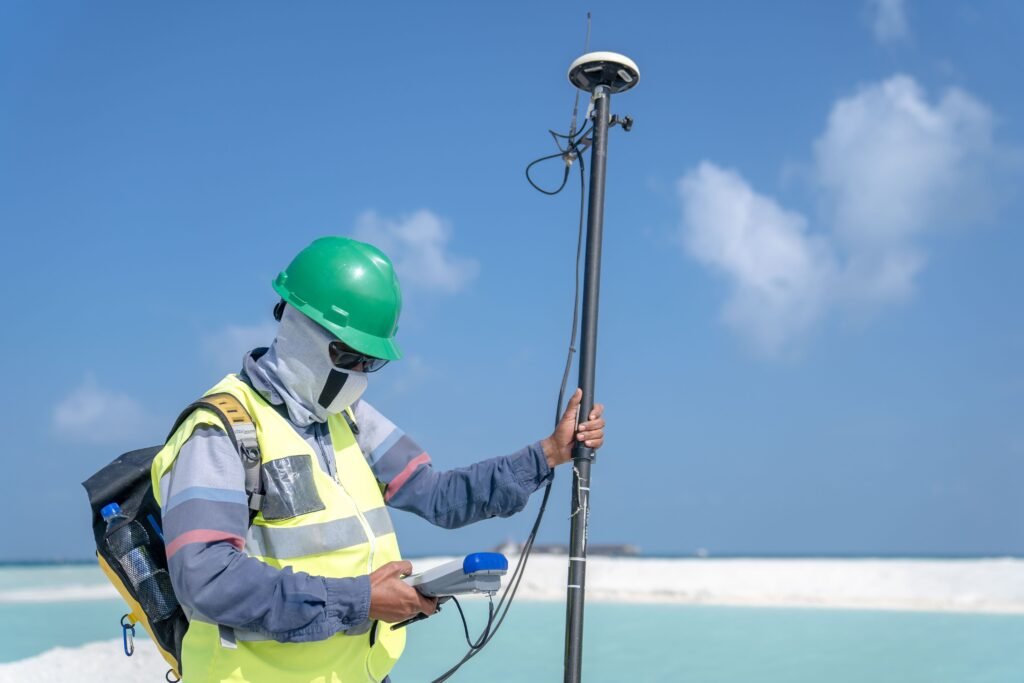
The rover is the mobile GNSS receiver used by the surveyor. It receives satellite signals along with correction data from the base station or correction network.
The rover applies these corrections in real time, allowing it to calculate highly accurate coordinates while moving through the survey area.
Real-Time Corrections Through NTRIP
Modern RTK systems commonly use NTRIP (Networked Transport of RTCM via Internet Protocol) to deliver correction data through the internet.
Instead of setting up a local base station, surveyors can connect to a Continuously Operating Reference Station (CORS) network and receive corrections directly on their GNSS receiver, improving efficiency and reducing setup time.
Equipment Used
Several components work together to perform an Survey successfully.
GNSS Receiver
A survey-grade GNSS receiver tracks signals from multiple satellite constellations and processes positioning information. Modern receivers support GPS, GLONASS, Galileo, and BeiDou signals simultaneously to improve accuracy and reliability.
Base Station and Rover Setup
An RTK setup typically consists of one base station and one rover receiver. The base station remains stationary while the rover moves throughout the project area collecting survey data.
Many surveyors today use network RTK services instead of establishing their own base station.
Data Collector and Survey Software
A data collector is used to manage field operations, store survey observations, and display coordinates. Survey software helps surveyors perform stakeout tasks, calculate coordinates, create maps, and export data for further analysis.
Accuracy of RTK Survey
One of the main reasons RTK Survey is widely adopted is its exceptional accuracy.
Why RTK Is More Accurate Than GPS
Standard GPS positioning can have errors ranging from several meters to tens of meters depending on conditions. RTK Survey removes much of this error by applying real-time corrections generated from a known reference point.
This correction process allows RTK systems to deliver significantly better accuracy than standalone GPS receivers.
Typical RTK Survey Accuracy
Under favorable conditions, RTK Survey commonly achieves horizontal accuracy between 1 and 3 centimeters and vertical accuracy between 2 and 5 centimeters.
The actual accuracy depends on equipment quality, satellite visibility, communication reliability, and environmental conditions.
Factors Affecting RTK Accuracy
Several factors can influence RTK Survey performance, including:
- Distance from the base station
- Satellite geometry
- Atmospheric conditions
- Multipath signal reflections
- Tree cover and buildings
- Internet or radio communication quality
Proper planning and equipment setup are essential for achieving the best results.
Applications of RTK Survey
RTK Survey is used across numerous industries where accurate positioning is critical.
Land Surveying and Mapping
Land surveyors use RTK Survey for boundary surveys, topographic surveys, cadastral mapping, and control point establishment. The technology enables fast and accurate field measurements over large areas.
Construction and Infrastructure Projects
Construction professionals use RTK Survey for site layout, grading, machine control, road construction, utility installation, and infrastructure development. Accurate positioning helps ensure projects are built according to design specifications.
Agriculture, Mining, and Drone Surveys
In agriculture, RTK Survey supports precision farming applications such as guidance systems, field mapping, and resource management.
Mining companies use RTK for stockpile measurement, excavation monitoring, and equipment positioning.
Drone surveys benefit from RTK positioning by improving the accuracy of aerial imagery, orthomosaics, and terrain models.
Advantages of RTK Survey
RTK Survey offers several important benefits compared to conventional positioning methods.
High Accuracy
RTK Survey delivers centimeter-level precision, making it suitable for engineering, construction, and land surveying projects where accuracy is essential.
Faster Data Collection
Surveyors receive accurate coordinates instantly, reducing field time and eliminating many post-processing requirements.
Reduced Human Error
Automated positioning and real-time corrections reduce the likelihood of mistakes associated with manual measurements and calculations.
Limitations of RTK Survey
Although Survey provides excellent results, there are some limitations that users should understand.
Signal Obstructions
Tall buildings, dense vegetation, tunnels, and other obstacles can block satellite signals and reduce positioning quality.
Dependence on Communication Networks
Survey requires continuous correction data from a base station or correction network. Interruptions in internet or radio communication can affect performance.
Equipment and Setup Costs
Survey-grade GNSS equipment, RTK subscriptions, and supporting hardware can represent a significant investment, particularly for smaller organizations.
Why Choose Geo Land Survey for RTK Survey Services?
At Geo Land Survey, we use advanced RTK Survey technology to deliver accurate and reliable survey data for land development, construction, infrastructure, mining, and mapping projects. Our experienced survey professionals combine modern GNSS equipment with industry-standard methodologies to ensure high-quality results for every project.
Whether you require boundary surveys, topographic mapping, construction layout, or drone-based data collection, Geo Land Survey provides professional surveying solutions tailored to your project requirements.
Conclusion
RTK Survey has transformed the surveying industry by providing real-time centimeter-level positioning accuracy. By combining GNSS satellite signals with correction data from a base station or RTK network, surveyors can collect highly accurate spatial information quickly and efficiently.
As demand for precise geospatial data continues to grow, RTK Survey remains one of the most valuable technologies for land surveying, construction, agriculture, mining, and drone mapping applications. Its combination of speed, reliability, and accuracy makes it an essential tool for modern surveying professionals.
Frequently Asked Questions
What is RTK Survey?
RTK Survey is a high-precision GNSS surveying method that uses real-time correction data to achieve centimeter-level positioning accuracy.
How Accurate It Is?
Under favorable conditions, RTK Survey can achieve horizontal accuracy of approximately 1 to 3 centimeters.
What is the difference between GPS and RTK?
GPS provides meter-level accuracy, while RTK applies real-time corrections to achieve centimeter-level precision.
What equipment is used in It ?
RTK typically requires GNSS receivers, a base station or RTK network connection, a rover receiver, a data collector, and survey software.
Where is RTK Survey commonly used?
RTK Survey is widely used in land surveying, construction, agriculture, mining, infrastructure development, utility mapping, and drone surveying.